![[Plot]](Images/parametricareaviaGreensThm_1.gif)
Find the area inside the loop given by r(t)=<sin(Pi*t),t-t^4> for 0 <= t<= 1, as shown below.
| > |
| > | plot([sin(t*Pi),t-t^4,t=0..1],color=black,thickness=2); |
First we use Green's Theorem. Let F = <M,N> be the vector field given by N = x and M=0. Now
area = int int (1) dA = int int (dN/dx - dM/dy) dA = (by Green's Theorem) int M dx + N dy = int x(t) y'(t) dt for t from 0 to 1.
Since y(t) = t - t^4, we get that y'(t) = 1 - 4t^3.
| > | int(sin(Pi*t)*(1-4*t^3),t=0..1); #This integral can be done using integration by parts three times. |

| > | evalf(%); |

Using Calc I methods you would need to define y1(x) for the top curve and y2(x) for the bottom curve and then integrate y1(x)-y2(x) for x = 0 to 1.
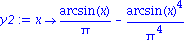
This is done below. See if you can figure out how to find y1 and y2. (Finding y2 is easier.)
| > | y2 := x -> 1/Pi*arcsin(x)-(1/Pi*arcsin(x))^4; #bottom curve
|
| > | y1:= x-> 1-1/Pi*arcsin(x)-(1-1/Pi*arcsin(x))^4; #top curve |

| > | plot([y1(x),y2(x)],x=0..1,color=[red,blue], thickness=2); |
![[Plot]](Images/parametricareaviaGreensThm_6.gif)
| > | int(y1(x)-y2(x),x=0..1);
|

| > |