This is the solution to #18 in section 2.3.
> with(DEtools):
We can use dsolve with initial value problems by putting {diff eq, y(a)=b} into dsolve like this:
> dsolve({diff(y(x),x)=(exp(-x)-exp(x))/(3+4*y),y(0)=1},y(x));
2 3 1/2
-3 exp(x) + (65 exp(x) - 8 exp(x) - 8 exp(x) )
y(x) = 1/4 --------------------------------------------------
exp(x)
There are many ways one could rewrite the equation for y(x). Maple's solution
is by no means in the best form. I prefer y(x) =-3/4+sqrt(65-16*cosh(x))/4.
But we will work with Maple's answer.
> plot(1/4/exp(x)*(-3*exp(x)+(65*exp(x)^2-8*exp(x)-8*exp(x)^3)^(1/2)),x=-4..4);
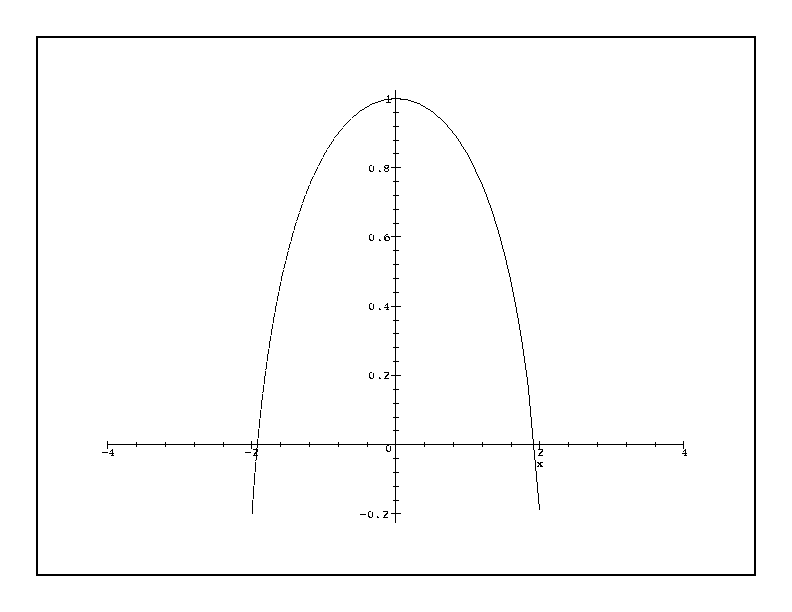 Looks like trouble around +/- 2. Below we plot just what is inside the radical:
> plot(65*exp(x)^2-8*exp(x)-8*exp(x)^3,x=-4..4,y=-1..10);
Looks like trouble around +/- 2. Below we plot just what is inside the radical:
> plot(65*exp(x)^2-8*exp(x)-8*exp(x)^3,x=-4..4,y=-1..10);
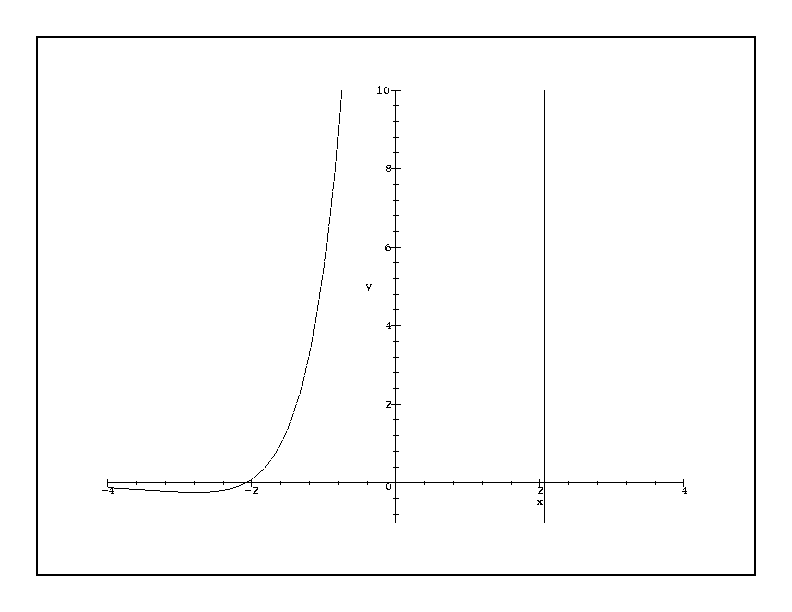 Clearly we only get a real solution for y(x) when the graph above is
nonnegative. Can we find the exact boundary for the interval ?
> solve(65*exp(x)^2-8*exp(x)-8*exp(x)^3=0,x);
-ln(8), ln(8)
Yes! Try that with your calculator!
Clearly we only get a real solution for y(x) when the graph above is
nonnegative. Can we find the exact boundary for the interval ?
> solve(65*exp(x)^2-8*exp(x)-8*exp(x)^3=0,x);
-ln(8), ln(8)
Yes! Try that with your calculator!