![A := matrix([[-3, 1, 2], [1, -3, 2], [2, 2, 0]])](images/81.gif)
Maple double check of problem #9 in 8.3
> with(linalg):
Warning, the protected names norm and trace have been redefined and unprotected
> A:=matrix([[-3,1,2],[1,-3,2],[2,2,0]]);
> eigenvalues(A);

> eigenvectors(A);
![[2, 1, {vector([1, 1, 2])}], [-4, 2, {vector([-1, 1...](images/83.gif)
> GramSchmidt({vector([-1,1,0]),vector([-2,0,1])});
![{[-2, 0, 1], [-1/5, 1, -2/5]}](images/84.gif)
These are different than ours. Notice Maple used the second first as the first one in the G-S process. We switch them below.
> GramSchmidt({vector([-2,0,1]),vector([-1,1,0])});
![{[-1, 1, 0], [-1, -1, 1]}](images/85.gif)
We normalize the three eigenvectors, the two for eigenvalue -4 and the one for eigenvalue 2.
>
normalize(vector([1,1,2 ]));
normalize(vector([-1,1,0]));
normalize(vector([-1,-1,1]));
![vector([1/6*sqrt(6), 1/6*sqrt(6), 1/3*sqrt(6)])](images/86.gif)
![vector([-1/2*sqrt(2), 1/2*sqrt(2), 0])](images/87.gif)
![vector([-1/3*sqrt(3), -1/3*sqrt(3), 1/3*sqrt(3)])](images/88.gif)
>
P:=transpose(matrix([[1/6*sqrt(6), 1/6*sqrt(6), 1/3*sqrt(6)],
[-1/2*sqrt(2), 1/2*sqrt(2), 0],[-1/3*sqrt(3), -1/3*sqrt(3), 1/3*sqrt(3)]]));
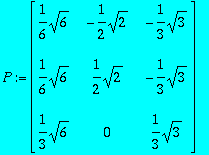
This is the same as the one we got by hand. Is in really orthogonal? Does in diagonalize A as the theory says it should?
> inverse(P);
![matrix([[1/6*sqrt(6), 1/6*sqrt(6), 1/3*sqrt(6)], [-...](images/810.gif)
Indeed P inverse equals P transpose.
> evalm(transpose(P)&*A&*P);
![matrix([[2, 0, 0], [0, -4, 0], [0, 0, -4]])](images/811.gif)
Check!
We use the jordon command to diagonialize A and construct P.
>
> jordan(A,'P');
![matrix([[-4, 0, 0], [0, 2, 0], [0, 0, -4]])](images/812.gif)
> evalm(P);
![matrix([[-7/6, 1/6, -2], [-1/6, 1/6, 0], [2/3, 1/3,...](images/813.gif)
jordan diagonalized A differently, and did not normalize P, nor is its P orthogonal.